
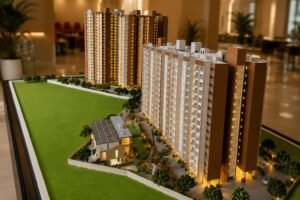

Ask three model makers whether 3D printing has changed their work and you’ll probably get three different answers. One will say it’s a revolution. Another will say it’s a useful tool but overrated. A third will say they still do half the work with a scalpel and a steel ruler.
They’re all right. The truth is that the best approach depends on your project, your timeline and your budget. If you’re thinking about ordering a 3d architectural model india for a launch, a review or a competition, understanding the differences will help you ask for the right thing.
What People Mean by a 3D Model
The phrase is slippery. Some people use it to mean a model that’s 3D printed. Others mean any physical model, as opposed to a 2D drawing. In practice, studios offer three broad approaches: models printed from digital files, models cut and assembled by hand and machine, and hybrids that blend the two.
Knowing which one you’re being offered avoids confusion. Ask the studio exactly how each part of your model will be made, and why.
Where 3D Printing Shines
Printing excels at complex shapes. A building with curved walls, sculpted façades or organic forms would be extremely slow to make by hand. A printer builds it layer by layer from your digital file, with accuracy that human hands can’t easily match.
It’s also good for repeat parts. Fifty identical balconies, a hundred identical trees or a set of sculptural columns can be printed in one go. And for small, intricate components, resin printers capture detail that would take hours to carve.
Where Printing Falls Short
There are limits. Prints have a maximum size, so large models must be built in sections and joined. Surfaces come out with fine layer lines that need sanding and painting. Large flat façades can warp slightly. And printed plastic can look slightly artificial if it isn’t finished carefully.
Printing isn’t always cheaper or faster either. A big, dense print can run for many hours, and failed prints waste time and material. For simple box-shaped buildings, laser-cut board or acrylic is often quicker, crisper and more economical.
The Case for Craft
Handwork and laser cutting still produce excellent results, especially for rectilinear buildings. Flat materials like acrylic, board and wood give clean edges, sharp corners and consistent thickness. Window frames, floor slabs and façade panels come out crisp and light.
Hands bring something else: judgement. A craftsperson can see that a roof edge looks too thick and trim it, or notice that a colour sits oddly beside another. Machines follow files. People notice whether things look right.
Hybrid Models Often Win
Most good studios mix methods. They might laser-cut the base, floor plates and walls, print a curved canopy and a sculptural feature, then finish everything by hand. This gets the best of each approach: speed where it’s possible, precision where it’s needed and character where it counts.
For you as a client, the point isn’t how the model was made, it’s how it looks and performs. Ask for samples, and judge based on the finish rather than the technology.
Cost Differences in Real Terms
Printing costs depend on volume, material and complexity. Large, solid parts cost more. Thin, hollow parts cost less. Laser cutting costs depend on sheet material, machine time and the amount of assembly needed. Handwork costs depend on the hours involved.
Rather than guessing, request an itemised quote with options. Many studios will price a version with a printed centrepiece and another with a fully cut and assembled structure. Seeing the numbers side by side makes the decision simple.
Finish Quality Is Where It’s Decided
Whatever the method, finish defines the result. A model with careful sanding, priming and painting will look more refined than a technically impressive one left rough. Ask about the finishing process: how many coats of paint, how surfaces are prepared and how glass and details are added.
Also check how the studio handles small elements like railings and window frames. These tiny parts show quickly whether the team has patience.
Think About the Indian Context
Projects in India have some practical features worth noting. Sales launches often run to tight, fixed dates tied to festivals or approvals. Models travel by road for long distances, through heat and humidity. Display spaces can be lit by strong lighting that exposes flaws and fades some materials.
A thoughtful studio plans for this. It chooses materials that handle heat and humidity, packs for long road journeys and tests lighting before delivery. These aren’t glamorous details, but they decide whether the model arrives in good shape and still looks good six months later.
Durability and Handling
A printed model and a cut-and-assembled one behave differently in the real world. Resin prints can be brittle, and a thin printed spire may snap if someone grabs it. Acrylic is stronger but can crack under sharp impacts. Board and foam are light but dent easily.
If your model will be handled often, such as at exhibitions or in a busy gallery, tell the studio. They can thicken delicate parts, add hidden supports or choose tougher materials. They might also supply spare parts for the most fragile elements. Spending a bit on durability is cheaper than repairing a model on the morning of a launch.
Colour Matching and Surface Detail
Colour is a more complicated subject than it appears. A grey on a screen isn’t the same grey on a painted surface, and both change under showroom lights. Ask the maker to prepare small colour samples under the lighting you’ll use, so you can approve the shades before the full model is painted.
Surface texture matters just as much. Printed models can carry fine textures directly, but they often look uniform. Hand-applied textures, thin veneers and painted effects bring variety, so brick looks like brick and concrete looks like concrete. A mix of the two often gives the most convincing result.
Time and Planning
Digital workflows speed up some stages, though not all of them. Preparing files takes time. Printing takes time. Finishing takes the most time. A large, detailed model can still take several weeks, however it’s made.
Give the studio your final drawings as early as possible, and agree on a date after which changes will move the deadline. Doing so reduces stress for everyone.
Models for Competitions and Tight Deadlines
Competition entries and launch dates don’t wait. If you’re up against a deadline, tell the studio on day one. Fast projects usually lean on laser cutting and printing for the heavy lifting, with finishing kept focused on the parts that matter most.
A tight schedule also demands quick decisions on your side. Send final files promptly, answer questions the same day and avoid late changes. Studios can often deliver a good model quickly, but they can’t do it if the information keeps shifting. Be honest about priorities too. If time is short, a simpler, cleaner model beats a complicated one that’s rushed.
Using the Model After the Launch
A model has a second life once the launch is over. It may move to a sales gallery, a corporate lobby or a site office. Photographs taken in good light become marketing images. Some developers use the model in investor meetings or take it to exhibitions in other cities.
Mention these plans when you place the order. A model that’s going to travel needs stronger joints, a sturdier base and a crate. One that stays in a single room can be more delicate and refined.
Questions to Ask a Studio
Ask what methods they use in-house. Ask which parts of your model they’d print and which they’d cut. Ask to see similar projects and, if possible, a finished sample. Ask how long finishing takes and how they handle revisions.
The answers will show how experienced the team is. Confident, specific replies are a good sign. Vague ones suggest that the studio may be relying on one tool for everything.
Choosing What Suits Your Project
Pick printing when your design has complex curves or many repeated, detailed parts. Pick craft and laser cutting for clean, geometric buildings and quick turnaround. Pick a hybrid when your design has a mix of both, which is most of the time.
Whatever you choose, keep the end goal in mind. People looking at your model won’t ask how it was made. They’ll ask what the building will feel like.
Final Thoughts
Technology has widened the options, but it hasn’t replaced good judgement. A well-made 3d architectural model india relies on a thoughtful mix of methods, careful finishing and honest communication between client and maker.
Talk to a few studios, show them your drawings and ask how they’d approach the job. A team that explains its reasoning clearly is usually a team you can trust. And when the right 3d architectural model india finally sits in front of your client, the method will matter far less than the way it makes your design come alive.